Checking and verifying news stories
In Substantiate mode, an individual has found a piece of information and wants to quickly and credibly confirm it. The desire is not full context or deep explanation. Audiences want to verify through trusted sources in a self-directed way that preserves their sense of agency, ensuring the information is factual, timely and fairly framed. To reach consumers in this mode, successful news producers create content that is promptly delivered after a breaking news event, focusing on main claims and facts, with simple, clear and digestible evidence at its core.
Consumer need
Substantiate mode begins when a consumer looks to verify a piece of news that has sparked suspicion. Consumers are not seeking deep understanding. Rather, they are looking to ensure the information they have come across is factual, timely and fairly framed.
Consumers tend to hold national and international political updates to a higher standard, especially if the subject is politicized in their media ecosystem. These subjects are more likely to trigger the Substantiate mode because the consequences of misinformation are perceived as greater than with other types of news.
In the Substantiate mode, audiences seek to verify information while preserving their own agency and understanding of truth. This often results in deep reliance on trusted news producers as fact-checking sources. In other cases, users rely on aggregating apps more than any individual news producer and draw conclusions about truth for themselves.
If something sounds unbelievable or too hyped, I check it against my trusted sources before believing it.
If I'm reading something tabloid-y or I think something might not be true, I read multiple sources and just compare what seems the most consistent.
Sometimes I verify news from TikTok when the comment section is 90% against what's being said in the news, if there's a 90% disagreement about what's being reported or presented.
Typos set off mini-alarms in my head. Good media houses run checks on everything they put out. So, to have typos, there has to be something wrong somewhere.
What triggers Substantiating?
- A desire to better understand a headline
- Content that seems too good (or too bad)
- Overly sensational language
- Civic or political content that reads as unfair or unbalanced, usually unflatteringly framing the consumers’ political leanings
- Rough grammar or image quality
- Possible use of generative AI for text or images
Substantiation behaviors
- Reading comments for fact-checking or shared suspicion
- Verifying headlines with trusted sources
- Searching to see if multiple sources reported similarly
- Checking bias-reporting aggregators to understand the "whole story"
The production challenge is to quickly provide clear, credible verification focusing on accuracy and simplicity without unnecessary context. Leading news producers ensure audiences can easily confirm what is true and move forward with confidence.
How news producers can respond
Meet Your Users
Deliver promptly, meeting users where they are and when they expect
Leading news producers facilitate substantiation by publishing information promptly after significant events occur or are reported. Next gen audiences expect emerging news producers to be on top of and help their audiences stay on top of timely news. They substantiate information on the platforms where their audiences spend their time.
- Prioritize accuracy and relevance over speed or volume. Leading news producers publish as soon as information is verified, ideally on the same day or within a few hours, but never at the expense of accuracy. Victor Marcello, co-founder of Quebrando o Tabu (QoT), a Brazilian digital media organization known for accessible, social-first journalism, explained: "We have a very deep understanding that we don't consider ourselves a news agency… We are not trying to be the first to provide information; instead, we focus on digesting and explaining the facts for the user." Leading news producers without significant team size and capacity avoid trying to substantiate every event. Instead, they focus on timely stories in which the issue has broad social or civic importance and there is a risk of misinformation or disinformation.
- Push information directly to audiences. Successful news producers build products that fact-check information or directly answer audience questions, including custom chatbots, WhatsApp communities or push notifications. For example, after regularly receiving emails and messages from its audience asking if certain facts in different pieces of content were true, Aos Fatos created a self-service chatbot (FátimaGPT) available across WhatsApp, Telegram and the web that allows audiences to fact-check information in the moment.
Aos Fatos
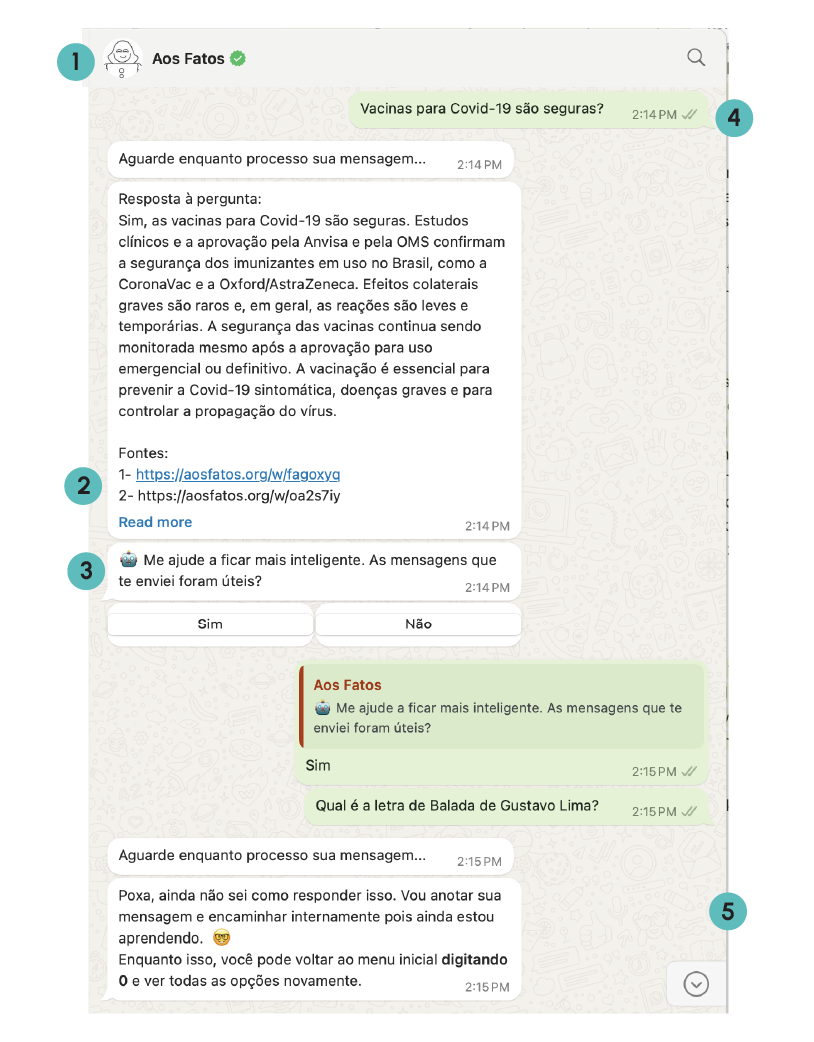
- Integration with WhatsApp for convenience
- Includes citation and links
- "Was this useful" AI reinforcement learning
- Ability to ask free-text open questions
- 'I don't know how to answer that' response if no relevant materials are returned via Retrieval-Augmented Generation
Lead With Facts
Start with the most important information and prioritize clarity
Leading news producers promote substantiation by delivering information audiences need for verification. In practice, this means providing essential factual information in a familiar, easy-to-consume format.
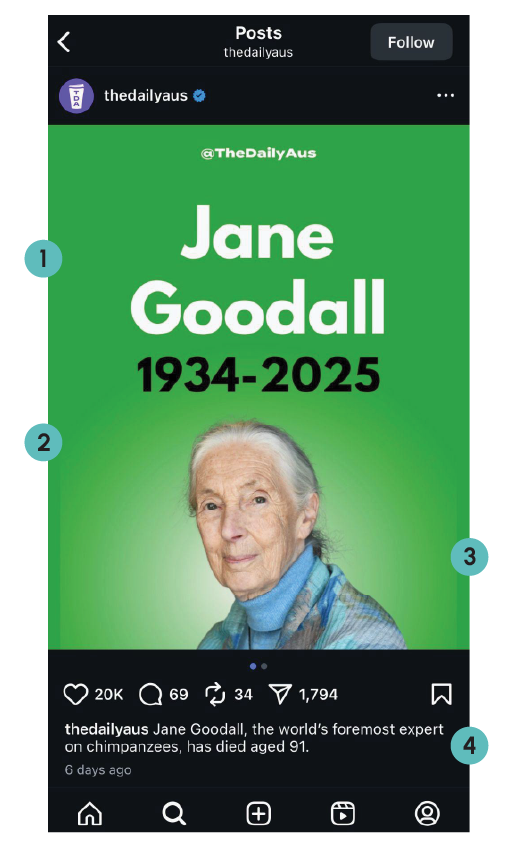
- Start with the claim. Successful news producers make it immediately obvious to users what story they are substantiating. For example, The Daily Aus uses Instagram Carousels in which the first card and caption tell the audience exactly what has happened ("Jane Goodall, the world's foremost expert on chimpanzees, has died aged 91"). As founder Sam Koslowski told us, "We believe in giving people the facts and information and explaining what it all means in as simple a way as possible, so that people can make their own decisions from there… We want to help everyone start from the same spot [of shared truths]."
- Create quick, easily digestible formats. Successful news producers use consistent templates to make information consumption fast and effortless. These templates include bullet-pointed slide carousels, short videos, or 50–100 word news cards. They write in a clear, accessible style that prioritizes understanding over analysis and use straightforward vocabulary, short sentences and paragraphs, and a neutral tone with little or no humor. As Tatton Spiller, founder of Simple Politics (SP), explained: "If you want hard-hitting journalism, we're not the page for you. ... If you just want a human friend talking you through what's going on, that's what SP is and that's where SP lives."
The Daily Aus
- Simple, very short, to-the-point title
- Plenty of empty space to avoid information overload
- Image/photo to further substantiate what happened / who was affected
- Brief descriptive sentence in the caption
Instagram Card 1
Instagram Card 2
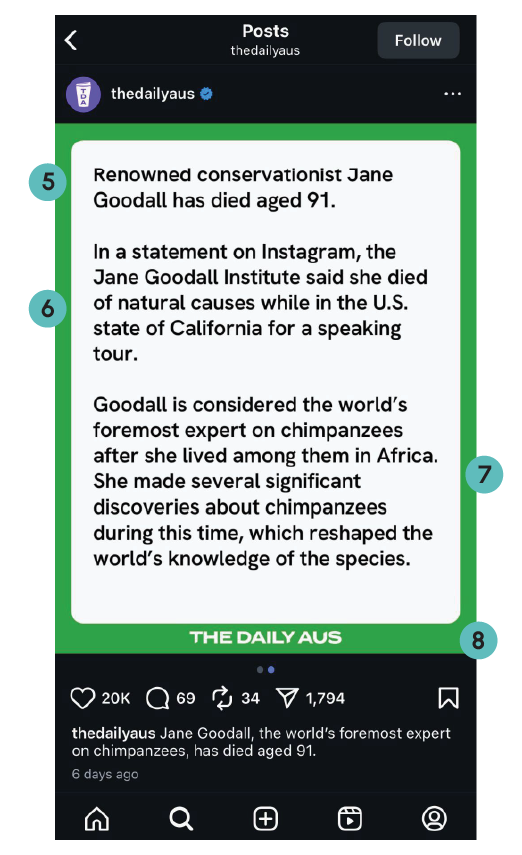
- Reiteration of what happened (in case people only see Card 2)
- Supporting evidence for the story
- Short context explanation
- Branding, in case screenshotted or sent
Show Your Work
Include evidence and show your process
Leading news producers facilitate substantiation by including information directly from the original source and making it available to the audience. This includes documents, datasets, original posts, video or audio. The point is to provide "receipts, not rhetoric," and to teach by showing people information rather than telling them.
- Stitch primary source materials into the content. Leading news producers clip or duet videos/audio, overlay screenshots of documents and include images so audiences can self-verify. UnderTheDeskNews often presents sources behind the presenter, such as maps of military facilities, to promote substantiation. These successful news producers clearly annotate from where information has come using overlays on videos or references in text, and they include links in captions and bios. TLDR News provides a full list of sources under each of its videos and categorizes them into sections that include links to the original materials. Equally important, these successful news producers are transparent when uncertain. They clearly state what has not been verified, avoid speculation and update or annotate previous posts as facts become clear. Akash Banerjee, creator of The Deshbhakt, follows this principle in livestreams by openly acknowledging when information is incomplete or outside his expertise, building credibility through honesty and by avoiding overconfidence.
- Show your working. Successful news producers speak in the first person to make the verification visible and relatable. For example, they say, "In this video, we found an anomaly" before explaining the methods used to confirm or challenge a claim. They walk audiences through each step of their process, such as reverse image searches, metadata checks, open-source database retrieval and data analysis. They also demonstrate how evidence was gathered and interpreted to help audiences understand the rigor and the limitations of the work. Aos Fatos provides a strong example of this practice. It publishes "all the sources that we used to subsidise our investigation and our fact checks. We also give the readers a brief review of how the investigation was conducted from the start to the end, which tools we used, what data we accessed and what decisions we made. This allows our readers to make a full assessment of how journalism is made."
UnderTheDeskNews
Address the truth
00:00 - 00:04
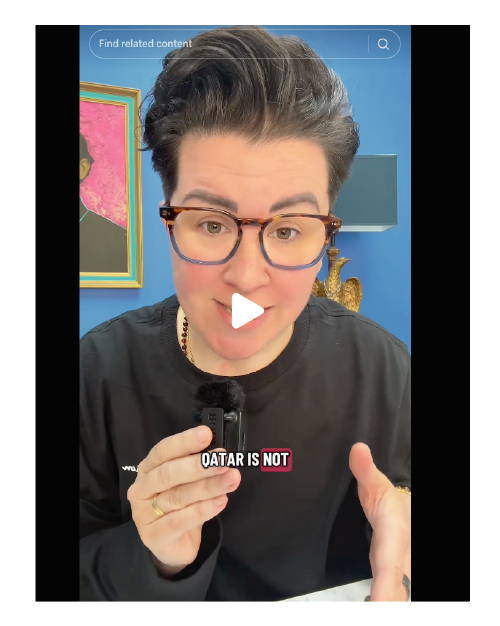
Transcription excerpt: 'Facts matter, Qatar is not building an air force base in Idaho'
Listen to the source
00:16 - 00:20
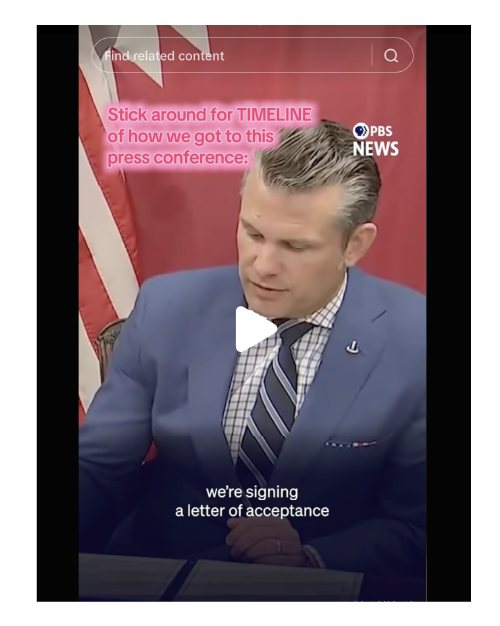
Transcription excerpt: "Listen for yourselves about what Pete Hesgeth had to say about the facility"
Show the evidence
00:35 - 00:45
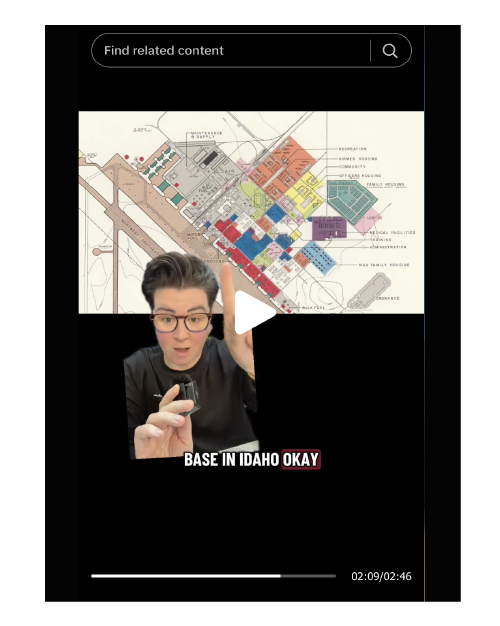
Transcription excerpt: 'Here is a publicly available map that shows the facility'