Modes of Engagement
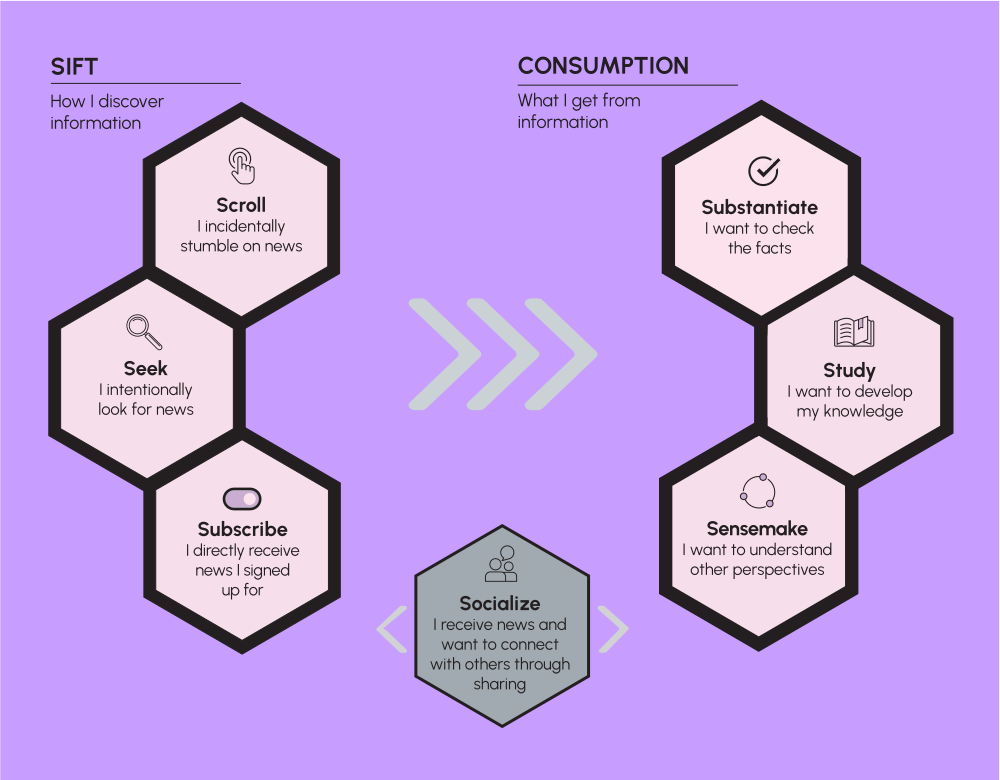
The preferences of news consumers, especially younger ones, spotlight their struggle to avoid information overload. They develop strategies to help navigate the flood of news while staying informed. Those strategies are mapped out in the Modes of Engagement. This new research enabled us to validate and expand on our original five modes. Further investigation showed the critical role sifting plays. Trust drives choices in the sifting mode, and relationships drive trust. All consumers start by selecting what to pay attention to and then transition to consumption modes that help them understand and learn from the news.
By tailoring content to specific modes, news producers can more effectively earn their way into next gen news consumers media routines.
Sift Modes
In sift modes, users filter through their chosen information environments to separate news from noise.
In our previous work, we identified “sift” as one of our five modes of news consumption and described it as follows:
In this mode, the next generation of news consumers need simple, low-effort ways to keep up with and discover relevant news and information amidst a glut of available content. They want to feel updated and in-the-know, without feeling inundated. Often sifting involves passive news consumption and can lead to consumers transitioning into the other modes.
Much of our previous description is validated by the data. Sifting is not a singular behavior but a collection of related modes that help consumers deal with the feeling that news overwhelm is greater than ever. Consumers are, indeed, looking for low-effort discovery methods that inform them without overwhelming them.
However, our 2025 data challenges the idea that sifting is passive. It is easy to assume that news consumption is a reactive activity on social media; we ourselves sometimes used “scrolling” as a synonym for “sifting.” The 2025 research showed that consumer sifting strategies actually cover a broader spectrum of intentionality.
Across all markets we studied, we found that young consumers actively curate their information ecosystems, seeking to reduce the daily mental load from sifting through endless content. Consumers intentionally mold their environment to refine and filter the news sources they encounter.
Observing this shaping process in the field showcases how sifting is richer than we originally defined. We now see it as three distinct modes of news discovery.
- Scrolling through algorithmic feeds is still very much present in our 2025 research. We no longer see that as the only method of sifting.
- Seeking occurs when users deliberately search for news stories or brands for deeper engagement).
- Subscribing happens when users choose to receive information via channels’ alerts, notifications, newsletters or group messages from specific trusted content sources.
All three sifting strategies may be ends in and of themselves. Some younger news consumers do not necessarily want to engage deeply and are looking for high-level information and headlines, content to go no further. For some, glancing at a list of headlines or knowing that news sources are in their feeds counts as discovery. These experiences of encountering news without going any deeper can still build trust in news providers and can lead to deeper future news engagement.
In this section, we discuss each sift mode in detail and recommend strategies for news producers to help them choose the right content, shape how it is presented and define how they engage with audiences across platforms. The goal is to design formats that use the right tone to support discovery and reduce cognitive load, ultimately easing pathways from sifting modes to consumption modes.

Scroll
Passively encountering news among other information.
- Package for the platform
- Select stories and topics that break through
- Win the first two seconds
Seek
Active searching for specific information with clear questions or topics in mind.
- Guide discovery
- Give control
- Personalize with purpose

Subscribe
Ongoing relationships with trusted sources through newsletters, podcasts, or habitual visits.
- Sync with habits
- Build for completion
Consumption Modes
In consumption modes, users have chosen to explore a subject, topic or piece of content more deeply.
Audiences are more likely to engage further when a story feels personally relevant, emotionally resonant or sparks their curiosity. How they first encounter that story does not dictate what happens next. Differing motivations shape how individuals choose to go deeper, whether by verifying facts, exploring context, or interpreting different perspectives.
In many cases, successful sifting leads to a deeper engagement mode, as news consumers delve further into a story of interest. Our 2025 findings reinforce the three modes we previously identified that capture how audiences engage more deeply with the news once they move beyond sifting. These modes are:
- Substantiating, in which users verify and cross-check information to confirm facts. This remains a central behavior, but our new findings suggest it is mainly triggered by suspicion — vague headlines, sensationalism, low-quality content or politicized topics.
- Studying, in which individuals dive into long-form or explanatory content to build understanding. Our findings disprove commonly held views that next gen audiences do not consume long-form content. With appropriate framing, structure and production value, young people will spend hours on a single piece of content.
- Sensemaking, in which audiences explore diverse perspectives and discussions and then form their own opinions. Our findings suggest that subtle design decisions and clear signpostings for the news producer’s own biases are increasingly important to next gen audiences as a signal that they are entering a space to learn and debate.
Substantiate
Verification and fact-checking by cross-referencing multiple sources for accuracy.
- Meet your users
- Lead with facts
- Show your work

Study
Deep learning and comprehensive understanding through long-form content and analysis.
- Show interest
- Go deep
- Bring it to life
Sensemake
Synthesis and meaning-making by connecting information to understand trends and implications.
- Create open conversations
- Orient the audience
- Include the audience
- Use satire wisely
Socialize
Socialize mode describes the interpersonal nature of modern news consumption. While our previous work listed this as an individual mode, our current data suggests sharing news is less a discrete consumption habit and more of a long-term relational action to be considered in its own context.