Receiving news from trusted people and sources
In the Subscribe mode, individuals receive news unprompted from a small set of sources they have deliberately chosen. These sources might include an emerging news producer they trust, a broadcast WhatsApp channel, a journalist, an expert or a publication. Updates arrive through various direct channels — emails, push notifications, group chats or platform alerts — when someone has turned on notifications for a specific account. In this mode, people expect timely, important or novel updates from sources whose judgement they rely on and do not want to miss.
Consumer need
Once a consumer has chosen to subscribe to a source, subscribe is the most reactive of all discovery modes. In this mode, consumers encounter news content brought to their personal devices from an external source, typically a newsletter, podcast or notifications from an app. These discovery streams require a high level of trust from consumers, as they invite interruption and potentially include challenging or upsetting information. However, notifications in particular were shown in the research to be unlikely to result in deeper engagement, unless the news was breaking or highly personally relevant. Often, as with scroll, headlines are as much as consumers need. Subscribing establishes and maintains a critical connection between brands and next gen news consumers, especially as those consumers move to other modes.
I'm able to follow and set notifications for news outlets that post about news that I'm interested in, and I get those notifications on my phone. I don't necessarily always open and read them. When I see the notifications, I do get information on what is happening, so I do appreciate that.
I really like getting the notifications about the news but also making it easy to ignore if I'm not in the mood to look at it. I tend to just read the headings which doesn't take long but then if I want to know more, I can easily click on the notification.
What Triggers Subscribe Content?
Subscribe is unique because content discovery is not directly triggered by consumer action.
- Receiving push notification from news or aggregator app
- Finding newsletters in an email inbox
Subscribe Behaviors
- Reviewing headline and preview summary, with no further action
- Clicking through to skim content in embedded links
In subscribe mode, news interrupts the flow of life. It appears unprompted through notifications, newsletters or messages and must immediately prove its worth. The production challenge is to make each interruption feel valuable, offering clear, relevant and timely information that rewards attention in that moment.
How news producers can respond
Sync with Habits
Design delivery around audience routines and preferences, not output cycle
Leading news producers put users first by delivering critical, relevant information that fits naturally into their day. Delivery feels timely and considerate, not intrusive. They give users control over what they receive and when, transforming push alerts into a helpful service. This also reflects the growing demand for customizable experiences, echoing our previous finding of a convenience gap in how audiences find news.
Offer Customizable Delivery
Top news producers let audiences choose which topics they receive updates on — such as breaking news, lifestyle or tech — and also the specific journalist, format or keywords they care about most. Some news consumers may want alerts tied to a favorite columnist, while others desire a recurring series, data stories or a specific theme. Successful news producers provide multiple delivery options, from app notifications, newsletter and SMS to messaging broadcasts on platforms such as WhatsApp.
Examples:
- The Guardian's myGuardian lets readers follow individual journalists, newsletters, podcasts and specific formats and receive dedicated push notifications, rather than only general "breaking news" or topic alerts.
- Michael MacLeod, the solo creator of The Edinburgh Minute, is planning to build section filters on his newsletters so readers can "take the full hose" or customize their newsletter to specific modules.
- Politico has returned to SMS texting to reach busy lawmakers and political staff with “personal and urgent” news to cut through the clutter of email inboxes and notifications.
Leverage Smart Scheduling by Aligning Delivery to Daily Habits
A well-timed morning briefing or pre-commute digest feels useful and builds routine; predictable timing becomes a form of trust. As Moritz Klein of The Pioneer notes, "Most people… will just start the podcast because it's part of their morning routine or their commute. It's super key that we land at 6 a.m." Being truly user-centric also means managing alert fatigue by sending fewer, better-timed notifications that feel essential rather than intrusive.
Examples:
- The Times of London caps its alerts at four per day to avoid over-communication.
- The Financial Times uses a hybrid model — broad news alerts for all users and personalized 5 p.m. updates for subscribers, complemented by morning briefings and weekend long-read digests.
- The Hindu has recently introduced a personalized push-notification strategy that sends alerts at optimal times based on each user's past behavior. This has resulted in an eight-fold increase in click-through rates.
The Guardian
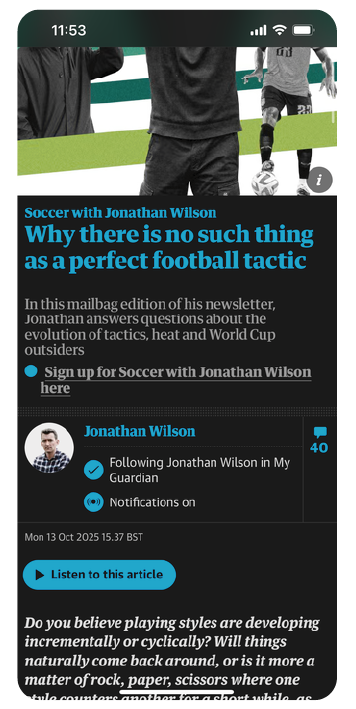
In article, The Guardian allows you to follow specific topics and authors, and turn on dedicated notifications
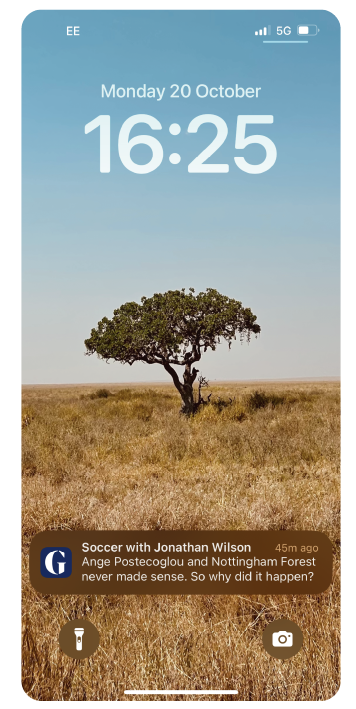
Anytime the author (in this case) Jonathan Wilson releases a new article, the user receives an automatic push notification
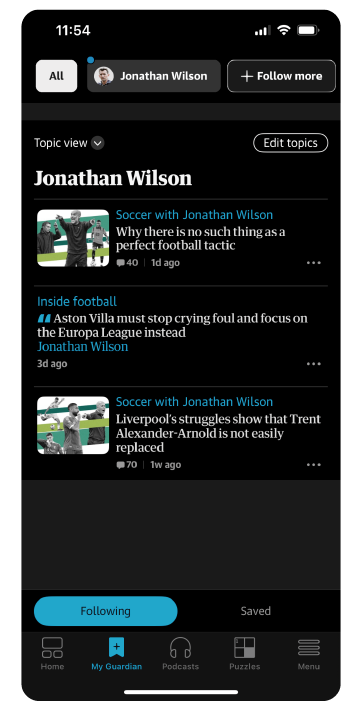
A centralized myGuardian hub allows users to review their followed topics / authors / newsletters and adjust notifications to personal preferences
Build for Completion
Make subscribe content dense and easy to complete
Leading news producers understand that many consumers interact with notifications, alerts, newsletters and chats in short time windows, between meetings or the first thing after waking up. This small window calls for information density and quick-to-complete content. Our previous research highlighted information density as key to closing the convenience gap — a need that has only grown as more people consume news via social media.
Standardize the Skeleton for Instant Scanning
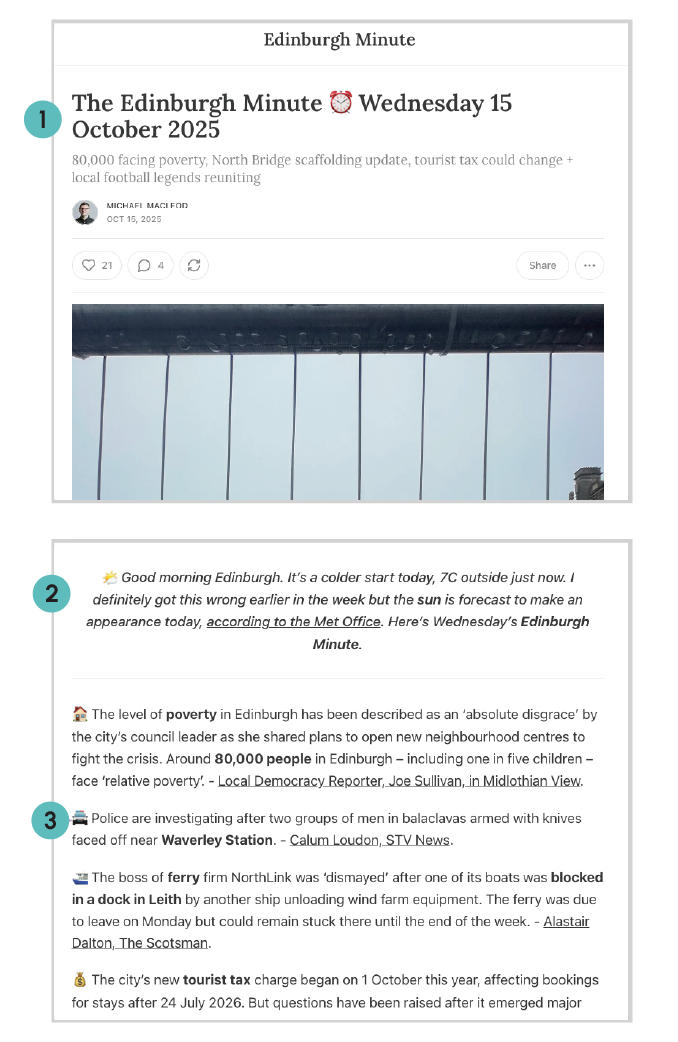
Successful news producers use a consistent, predictable layout so readers know exactly where to look — an opening line that explains the one big thing they will take away, clear section headers, visual signposts (emojis or icons), bullets, and links. The Edinburgh Minute exemplifies this discipline. Every issue follows the same structure, ordered by impact on daily life, participation and light relief. As founder Michael MacLeod notes, "I will always keep this exact same structure so that it is scannable… I'll even include an introductory note to help people skip to the most relevant part." This is tapping into the 1/5/10 strategy outlined by newsletter specialist Dan Oshinsky. In this theory, the key insight comes first, deeper content follows, and a bite-sized bonus section finishes. This consistency gives readers confidence and makes attention a habit. Tone then completes the experience. Hard news formats are direct, neutral and fact-led, while personality-driven newsletters tend to be warmer and conversational.
Keep It Short, but Provide Options to Go Deeper
Top news producers include only a short headline for alerts and notifications, with an image, a subject line of six words or less. They make newsletters readable in less than three minutes, and they keep broadcast messages short — one to three sentences per update. These news producers give people the option to learn more (e.g. via external links).
Example: Deepit Purkayastha, co-founder and CEO of Inshorts, notes that to meet this user need, they have recently "launched something known as daily digests of your interests. ... You tell me what are the two, three or five things that you want a sense of completion on every day [and we will notify you of those]." Inshorts also allows people to tap in the app to click on specific story cards that they are interested in to go deeper on a topic.
The Edinburgh Minute
- Plain language updates on the key contents of the newsletter
- A softer tone for the introduction usually focusing on weather or the author's mood
- A long list of key stories, each with two sentences max, along with an emoji to introduce the topic, and a follow-up link
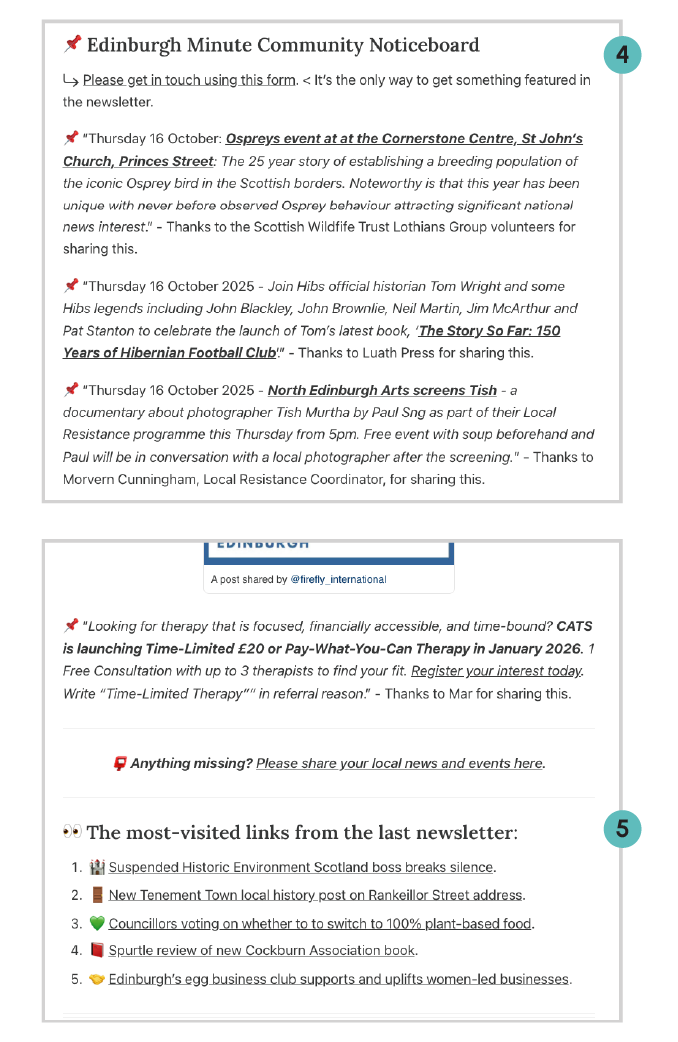
- The Community Noticeboard after the news, where members can share links to events and things happening in the city
- Most-visited links from last newsletter, to help people stay up to date in case they miss any edition