
Deep-diving into a particular topic or ongoing story to build knowledge
In Study mode, individuals dive deeply into a topic or ongoing story that has captured their interest or supports their personal or professional growth. This mode is driven by a desire to learn, upskill and be inspired. But for some, Study mode is a pleasant distraction. To reach consumers in this mode, producers can create long-form, information-dense content that has high-production value to keep engagement high, while showcasing their lived experience as a means to draw users into the story.
Consumer need
In Study mode, consumers dive deep into a particular topic or ongoing news story that has piqued their interest for the sake of personal fulfillment or professional development. A segment of consumers also study as an enriching form of entertainment. Although consumers spend much of their time scrolling through news content or engaging with it only at a very high level, they still are willing to move into Study mode and engage deeply with the nuance and context of complex news stories. When they enter this deeper mode, they crave spaces that educate, upskill and inspire them with rich, well-researched information.
I searched for in-depth videos about the economy right now. I wanted to know about, like, inflation and the whole tax tariff thing. So it was something I felt like I have basically no knowledge of, but I do worry about it because of how I hear word-of-mouth between family and friends….I honestly don't have a lot of knowledge about this. So I looked up on YouTube maybe just trying to get acquired or just understand a point overall what's occurring…
When I watch a [long-form] video, I not only hear the news, but also see interviews, visuals, and detailed breakdowns, you know, which help me understand a bigger picture and what's actually happening.
What triggers Studying?
- Highly relevant news stories that extend personal interests or upskilling
- Civic stories that require higher understanding levels for full context, such as the intricacies of tariffs
- Ongoing, recurring news stories that require timelines and context, such as the history of the Israel/Palestine conflict
- Desire for entertainment that passes time during another task, such as exercising, cooking or eating, and feels productive and educational
Studying behaviors
- Moving from a headline to the actual content from the same source
- Searching for long-form content from a trusted source
- Consuming long-form video and audio content as pastime
In Study mode, audiences choose to slow down and go deep. They seek context, expertise and well-crafted explanations that help them understand complex issues or build personal knowledge. The production challenge is to reward this deliberate attention with depth that educates and inspires — transforming information into lasting understanding.
How news producers can respond
Show Interest
Highlight personal interest in a story and share what was learned along the way
Leading news producers understand that people want to learn from passionate individuals. To do that, these producers share their personal curiosities, professional experiences, gaps in knowledge and occasional errors as part of the learning journey. This openness becomes a teaching device. It also addresses a deeper shift we identified in our previous research: Audiences feel greater affinity for news producers who come across as family or friends rather than distant teachers.
- Open with the motive, not just the topic. In the first 15–30 seconds or first paragraph, successful news producers state why they care. They reveal the puzzle or lived experiences that informed the story. They also keep it specific and verifiable. For example, they refer to "A price increase on my grocery receipt I couldn't explain." Mohak Mangal continuously does this in his videos, grounding complex national issues in his own curiosity and daily life before expanding to the larger story. When exploring the fake paneer scandal — the widespread adulteration of India's popular cheese in which producers use cheap substitutes or even chemicals — he connects with viewers by beginning with a personal hook. Another example is BellaNaija, which was launched in 2006 to spotlight Africa's beauty amid news that frequently focused on violence and poverty. The founder's personal frustration grew into a platform that continues to change perceptions of Africa.
- Use mini-brands or shows as a creative sandbox. Successful news producers experiment with sub-franchises that have their own unique names, tones, talent and aesthetics with subtle ties to the parent brand. Morning Brew uses this franchise approach by spinning off some of its most-known shows (Good Work) or by acquiring new emerging news producer-led shows (A Show About The News). As Macy Gilliam explained, "One creator does start to finish [ideation, writing, filming, editing], which I think is part of what makes it so good. It lets us each have individual styles where it's not like we're all going through the same editor that then makes everything feel very similar."
Mohak Mangal "I Investigated The Fake Paneer Scam"
In Mohak's introduction, he addresses why he's interested in the topic and what pushed him to investigate
00:00 - 0:50
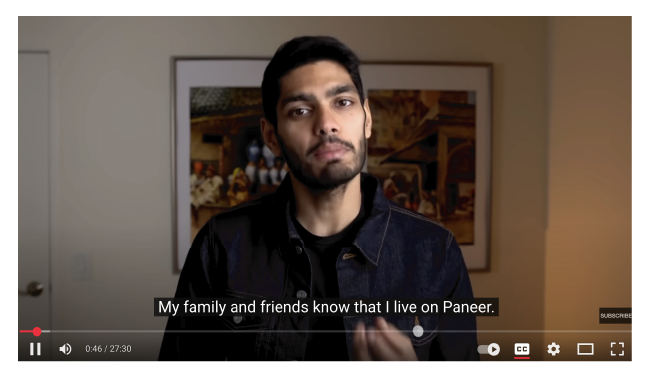
Transcription excerpt: "The Paneer you're eating happily, is it real or fake?... My family and friends know that I live on Paneer. So my team and I decided to investigate this fake Paneer scam taking over India."
He then uses on-the-ground interviews as well as animations to 'set the scene' and place it in the wider context
00:50 - 10:40
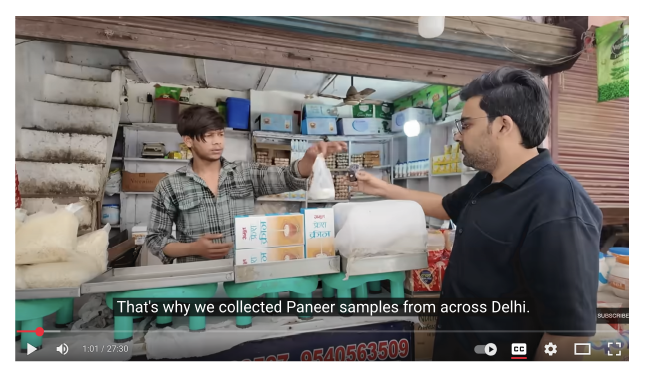
Transcription excerpt: "That's why we collected Paneer samples from across Delhi: from dairies, restaurants, stalls...We carried out the Iodine test for each sample and got some unexpected results."
Lastly, he shows how he created an experiment to debunk or prove his hypothesis
10:40 - 27:30
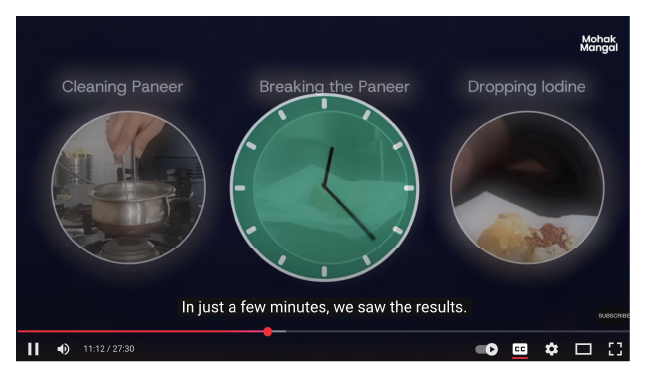
Transcription excerpt: "That's why we followed Dr. Aparna's advice. We washed the Paneer, we broke it down into pieces, then we added the iodine to the inner and clean portions and in just a few minutes we saw the result."
Go Deep
Use long-form and information-dense content to build lasting value and understanding
Leading news producers meet the demand for knowledge with long‑form, information‑dense content that serve as mini‑modules. They introduce a clear question as a foundation and build concepts, show evidence and synthesize takeaways. The result is durable value and content that is saved, watched and rewatched long after publication.
- Start with a learning goal to orient the audience and prime attention. Successful news producers open with one clear line — "By the end, you'll be able to explain…" — so viewers know what they will gain and why it matters. HowTown's videos exemplify this by examining the evidence behind commonly held claims, asking, "How do we know that X happened?" As co-founder Adam Cole explained, "Our job is to share information and help people understand where the information comes from so they can evaluate it themselves." From there, these successful news producers frame deeper civic or societal questions. They explicitly name what is at stake, who benefits or how policy decisions shape everyday life. Economics Explained, for instance, publishes only a few videos per month, each anchored to a big civic question such as, "Is this the recession the US needs to have?" Together, these techniques address a broader shift identified in our previous research: Younger audiences increasingly expect news to be directly actionable — something that helps them understand, decide or do something, not just helps them stay informed.
- Favor evergreen or under-explored themes. Leading news producers prioritize topics that matter in the long term, such as macroeconomics, history, science or common myths. As Jan Diehm, founder of the data-driven and long-form scrollytelling producer The Pudding explained, "Our projects take two to six months, sometimes over a year. So, we're purposely picking things that have a really long shelf life and a really long tail." The Observer's weekly The Slow Newscast is a similar example via audio. It mixes investigation into lesser-known details of topical stories — such as wars, economic policy and crime — with explorations of evergreen topics like immortality, childcare or the quest to save whales.
- Build concepts progressively. Successful news producers move from fundamentals to nuance and summarize each section in one clear sentence before moving on. This chunking guides understanding and prevents audiences from becoming lost in detail. Ros Atkins, the BBC presenter known for his 5-10 minute explanatory videos, has a seven-step method to achieve this: (1) set up, (2) find, (3) distill, (4) organize, (5) link, (6) tighten, (7) deliver. HowTown goes a step further with its 15-plus-minute long-form videos that have clear chapter markers and distill key information while allowing users to easily go back or skip specific sections.
HowTown
- Clear timestamp in the video title to set expectations. Interlude between animation and live interviews for pacing.
- Live interviews are used at end of each section as recap and explainer
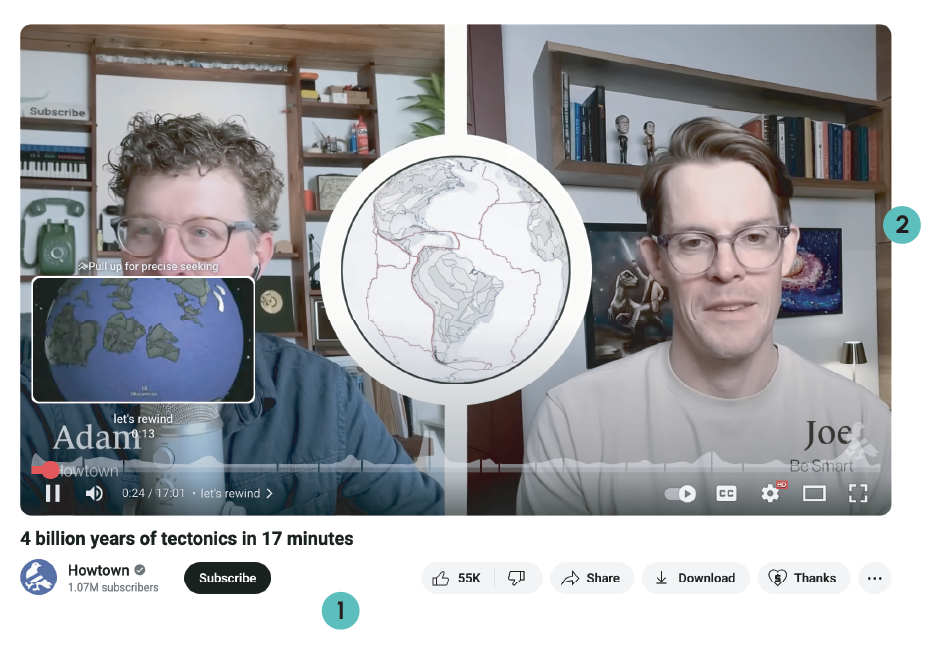
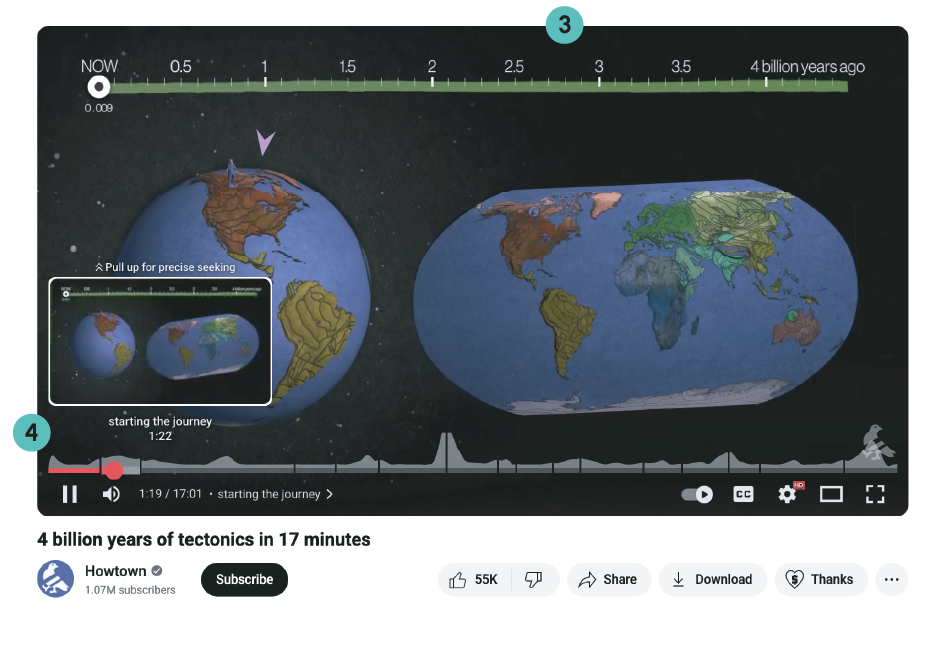
- As this story focuses on the tectonic evolution of the world, HowTown uses a visual timeline across entirety of the video to locate 'where in time'
- Clear chapter-markers for people to understand which part of the video they are in
Bring It to Life
Show on-the-ground reporting and add production value
Leading news producers understand that audiences want to learn directly from the source and see things for themselves. To do this, these producers clearly show how they have gathered information and add smart design elements as cognitive aids. The combination of presence and production craft signals care, credibility and purpose — key ingredients in deep learning. These also respond to a wider need identified in our previous research: News producers feel more credible when they showcase lived experience and demonstrate proximity to events and the people affected by them.
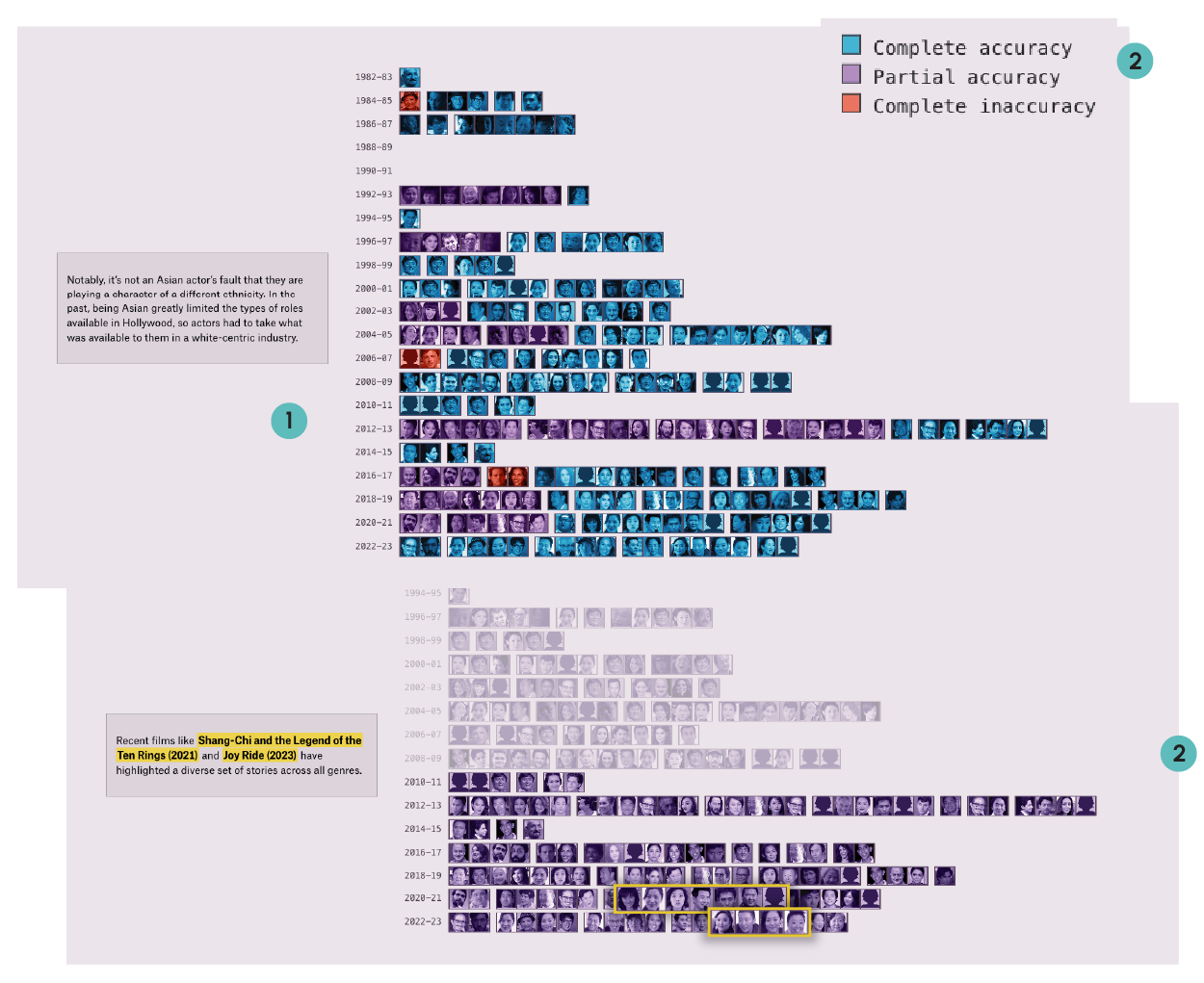
- Gather original evidence and showcase it in original ways. Leading news producers collect first-hand material through research, data gathering, open-source intelligence (OSINT) and interviews with experts or the people directly involved. Original data and primary sources signal rigor, broaden what counts as evidence, and strengthen their ability to explain not just what is happening but how and why. The Pudding, for example, built an original dataset from thousands of films to quantify Asian representation in Hollywood. As journalist Jan Diehm explained, "In the data viz world there are two schools of thought. One says minimalism works best — the data should speak for itself — and the other more experimental field, where we fall, creates memorable capsules. There's a famous chart we once made that is shaped like a monster, with the jagged data-line as its teeth, and research shows people remember that version far more than a simple line chart." Another key principle successful news producers show is the importance of being on-the-ground: They go on location to add sensory detail and context. Creator Cleo Abram combines studio explanations with field reporting — filming inside a zero-gravity facility to explore the science of space travel, for example — to bring experiential evidence to her work.
- Show your process and develop a signature form. Successful news producers break down stories step-by-step so audiences can follow their reasoning and see how conclusions take shape. They use visual walkthroughs — maps, timelines or annotated documents — to make topics tangible. Johnny Harris exemplifies this in his map-led explainers. He does not just use maps. He designs and redesigns them on screen, walking viewers through how he combines satellite imagery, historical cartography and his own graphic layers to uncover patterns and meaning. The act of constructing the map becomes the story itself. Sportsball applies the same principle through its hand-drawn charts and diagrams, which take shape in real time as the host unpacks the business of sport. The evolving sketch clarifies ideas and creates a recognizable aesthetic. In both cases, form mirrors process, and audiences see the thinking unfold.
The Pudding "Asian misrepresentation in movies"
- Gathering original data. In this case: 80 films from 1982 to 2023, with 160 Asian actors playing 236 characters that are central to the film, to investigate whether they are misrepresented.
- Explaining their reasoning behind how they gathered data and showcasing it through a 'scrollytelling' format with original design
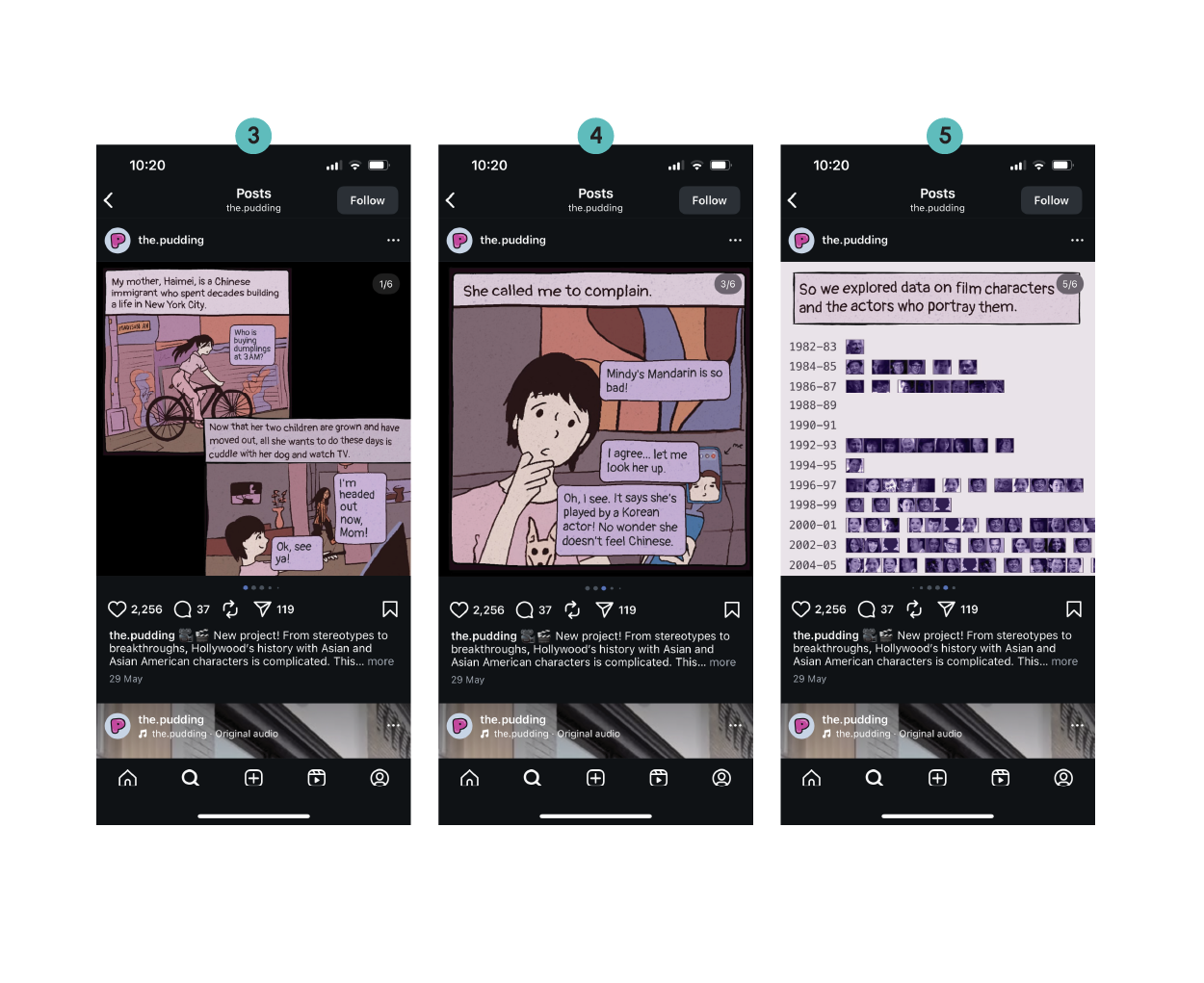
- Use of a personal story behind why The Pudding looked into this topic
- Use of cartoons to stand-out while people 'scroll' through their feeds
- Clear follow-up action to read the whole story