
Actively looking for news or even specific news topics
In the Seek mode, consumers intentionally choose to engage with news through a trusted source. Their goal may be to stay informed, learn something new or find clarity on a topic they have already encountered. This is a highly intentional mode of engagement, where consumers look for efficient, information-rich content that delivers depth and relevance without distraction.
Consumer need
In the Seek mode, next gen consumers actively look for news content. Whether they are searching for a broad overview of the day's news or a specific update, consumers are highly intentional in this mode and seek efficient, information-rich content.
In cases where seeking is not topic-specific, consumers rely on trusted sources to curate their news for them and educate them on what is important for them to know that day.
Consumers are more likely to engage deeper when they are in Seek mode than in other discovery modes, because they are already in the mindset to consume news.
I don't use the Times of India consistently every single day, but a few times a week, I visit it when I really want to catch up on important news or to find some specific information. Usually, something triggers my interest like hearing about a major event, political update, sports result, or a trending story—and I go to the app or website to get the full details. I trust it because the news is well-structured, easy to read, and covers both national and international topics, so I can quickly get a clear picture of what's going on.
This news story I was actually looking for personally, because I saw something near my house where it was all police taped-off. So I wanted to have a look, see if it had been put on, and it did get put on.
What triggers seeking?
- Wanting a summary of important news for the day
- Looking for updates on an ongoing story of interest
- Investigating a story they heard about from family, friends or online discourse
- Reading updates on a specialized interest (e.g., hobby, career field, activist interest)
Seeking behaviors
- Visiting a trusted news-exclusive website or app for top headlines
- Visiting an emerging news producer for headlines or a news roundup
- Pulling up and listening to an aggregator or headlines podcast (e.g., The Guardian's Today in Focus, NPR Morning Edition or Il Post's Morning Post)
- Scrolling an aggregator for top headlines
- Searching for a topic on a search engine, paying special attention to trusted sources in the results
In Seek mode, audience members arrive with purpose. They know what they want and expect to find it quickly. The production challenge is to anticipate these information needs and make depth accessible without friction, ensuring that credibility, clarity and efficiency guide every interaction.
How news producers can respond
Guide Discovery
Ease discovery through thoughtful curation and an intuitive interface
Leading news producers facilitate Seek mode by helping their audiences find content that feels purposeful and personally relevant while meeting the desire for convenience. They demonstrate a strong understanding of what their readers are looking for and show clear editorial intent and judgment that aligns with those needs, supported by product design that makes discovery effortless and intuitive.
- Deliver curated briefings. These leading news producers apply editorial judgment to select and package news stories that matter most to their audience. They deliver them consistently across channels (for example, newsletters or audio) and times of the day to build routine and repeat engagement. The Pioneer Briefing — the flagship audio product from The Pioneer — capitalizes well on this approach. Framed as "news without noise," it filters the day's events into five essential stories and two deeper explorations, designed to leave listeners feeling informed and educated.
- Offer live formats that capitalize on immediate interest. Successful news producers use real-time channels, such as on-site live blogs and social live streams, to blend updates, evidence, imagery and short explanations for major unfolding events. The Guardian's live blogs exemplify this principle. Prominent "Key events" and "What we know so far" cards ground readers from the outset, while a mix of rapid updates, contextual analysis and multimedia maintains clarity and momentum throughout coverage. Each post carries the journalist's name and icon, lending a human presence and approachable tone that makes the coverage feel dynamic. The format manages to be both fast and coherent, delivering the urgency of live news without sacrificing clarity or depth.
- Create seamless, intelligent discovery experiences. Leading news producers optimize on-site and in-app search to support both keyword and semantic queries, with filters for date, author and format, and options to sort by relevance or recency. Advanced news producers extend this with generative AI tools that provide summarized, citation-backed answers based on verified reporting. For example, the Financial Times has built its own GenAI Chatbot, “Ask FT,” that uses Retrieval-Augmented Generation (RAG), first retrieving relevant snippets from the Financial Times article archive and then using an LLM to generate an answer based solely on that trusted, retrieved content.
- Design intuitive interfaces within owned and operated platforms. Successful news producers keep interfaces low-clutter, with clear signposts for key themes on landing pages. Where possible, they integrate advertising that feels native and non-disruptive. A good illustration of this principle is Inshorts and its clean, card-based mobile interface. Each story is distilled into a 60-word summary, allowing users to absorb headlines at a glance while maintaining narrative coherence. The swipe-based navigation reinforces momentum, reducing friction and matching mobile-first reading habits. For deeper engagement, each card expands into a full-length article or related coverage, giving users seamless control over how much detail they consume.
Inshorts
- Inshorts App landing page takes you directly to a story, as opposed to a homepage - encouraging instantaneous discovery and reducing overwhelm/choice
- Social cards are designed to intentionally avoid clutter and only share key information (with the option to 'tap to know more')
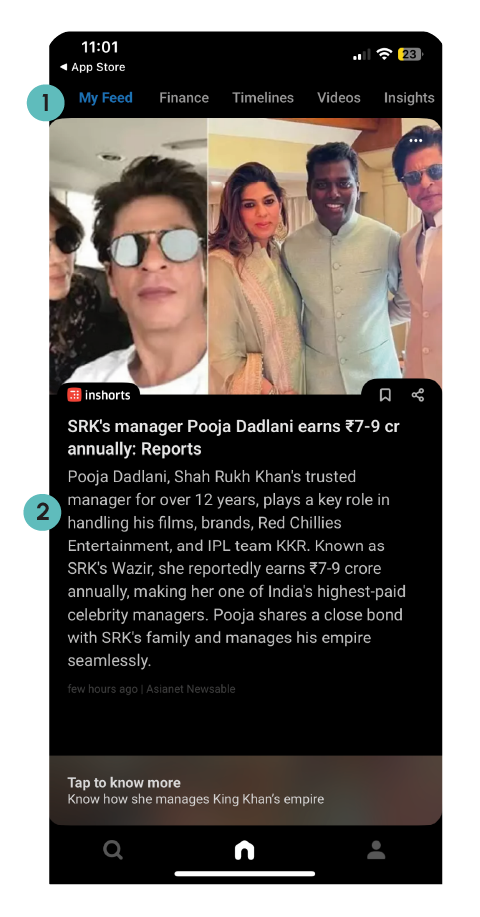
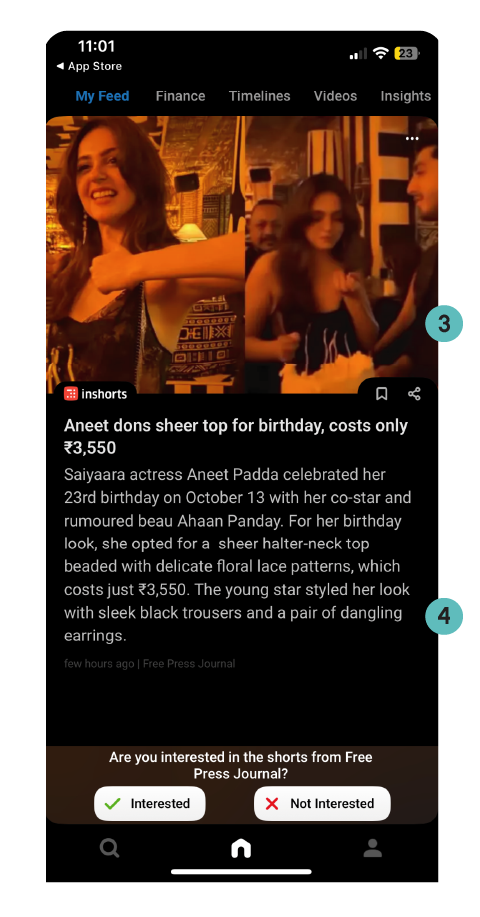
- All story cards follow the exact same format (image size, amount of text, citations)
- Users can simply 'flick up' to go to the next story (mirroring behavior on popular social platforms like TikTok)
Give Control
Create ways for users to customize their news experience to improve discoverability
Leading news producers provide customization features within owned and operated platforms that let audiences shape their experiences of the news. In practice, customization elevates what matters for each person and tunes delivery to individual preferences so content is immediately relevant and worth attention.
- Successful news producers enable meaningful personalization and control. They allow readers to follow topics or authors and use these preferences to shape personalized feeds across email, websites and apps. The Verge's follow buttons create a custom homepage and daily email digest tailored to each user. As Jacob Kastrenakes, executive editor, explains: "You'll notice this feels a lot like the way an RSS feed or a social network works. That's very much by design. Everything is a feed now, and everything is customizable. We think our site should work the same way. What you're seeing today is the first step toward adding deeper personalisation features." In addition, top news producers make it easy for audiences to update preferences or mute content they no longer want via inline chips, a central preference center or gentle prompts.
- Successful news producers allow audiences to tailor content to their preferred format, whether reading, listening or watching. Zetland offers narrated versions of its articles, read by the reporters themselves. These leading news producers sometimes leverage generative AI to produce alternative formats at relatively low cost. For example, the Financial Times partners with ElevenLabs to produce lifelike audio versions of articles. News producers are also using AI to offer customizable summaries of content. Particle News, an AI-powered news aggregation app, allows users to choose from a selection of AI-generated summaries that include "The 5Ws," who, what, when, where, why, and "Opposite Sides," which offers contrasting viewpoints on a story.
The Verge
- Users can select authors or topics that they are interested in
- Topic categories are intentionally granular and more specific than section headers
- Preferences are stored - and can be updated - via a central account page
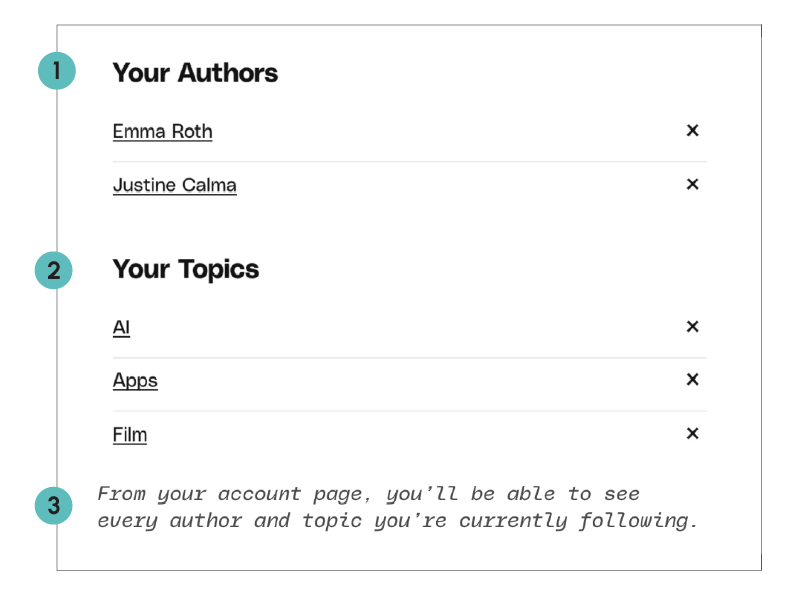
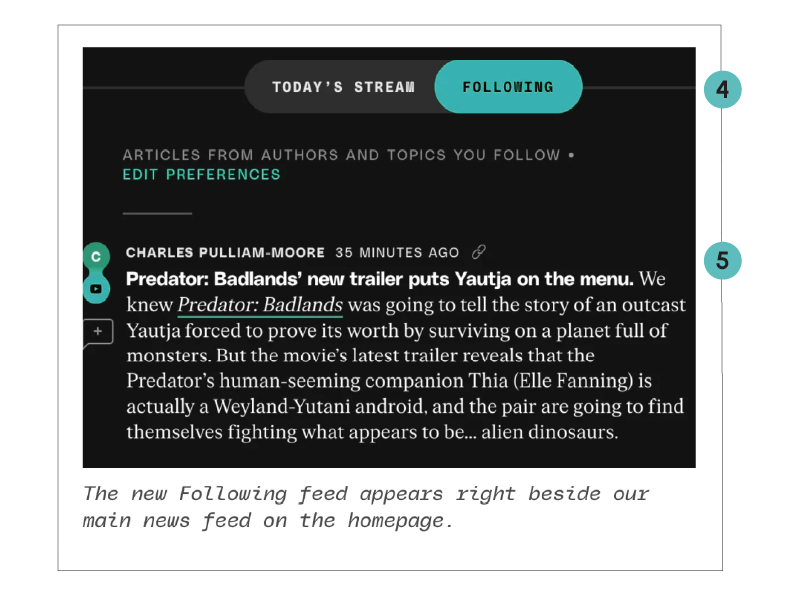
- The 'Following' page is a separate location where audiences can see their customized topics / authors
- Information is presented as a feed with summaries and the opportunity to click-through to learn more
Particle News
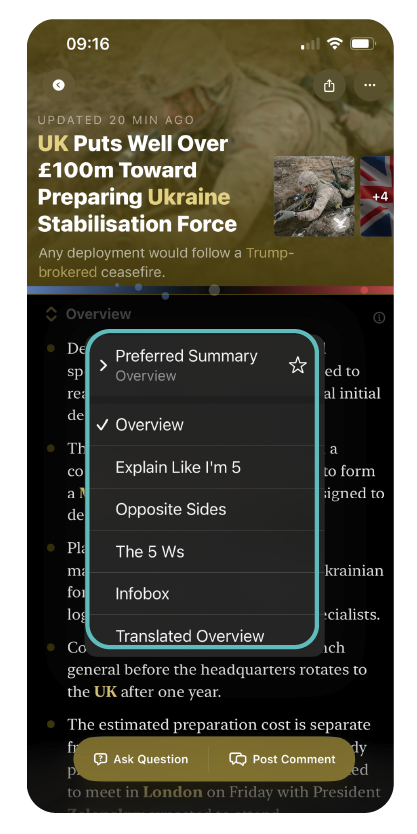
- Using AI, Particle gives readers the option of displaying a news story in 6 different ways
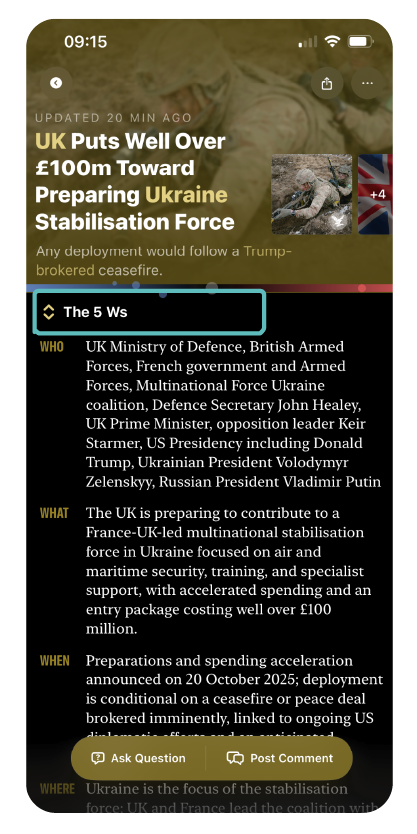
- The 5 Ws (Who, What, When, Where, Why)

- Opposite takes on the same story
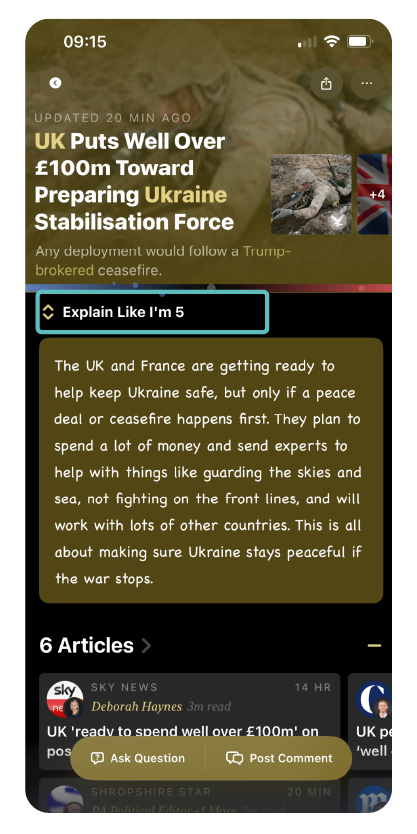
- Explain like I'm 5, for simple explanation
Personalize with Purpose
Blend user control and intelligent personalization
Leading news producers facilitate Seek mode by balancing editorially led curation, audience-led customization, and data-driven personalization to meet individuals' need to consume topics of personal significance. Younger audiences seek discovery that feels guided but open — an experience that recognizes their interests while continually serving them new perspectives and ideas. This is typically achieved through a carefully designed onboarding journey.
- Recommend content that is likely to be of interest to an individual. Leading news producers combine behavioral signals (what they consume) with demographics (location, age) to inform content recommendations. They label personalized recommendations — for example, "because you read about climate policy" — to help users understand and trust personalization logic. They also allow users to opt out of content personalization via account settings or preferences. For example, The New York Times recently made "one of its biggest changes" by launching a bottom navigation to the "You" tab customized by a user's behavior. As Kristen Dudish, vice president of product design, explained: "We wanted to balance discovery with finding something to read or watch based on their habits or the affinities that people have for specific sections." The New York Times also offers personalization in the Today feed, though it is an "80/20 split between editorial curation and personalization".
The New York Times
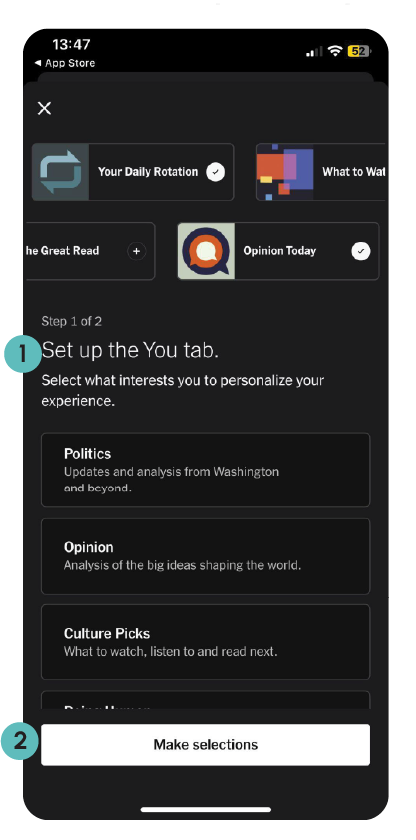
- To set up the You tab, NYT asks for your interests and preferences to inform algorithmic selection
- Options include newsletters, audio and video formats to cater to different audience preferences
"You" Set Up Journey
"You" Feed Page
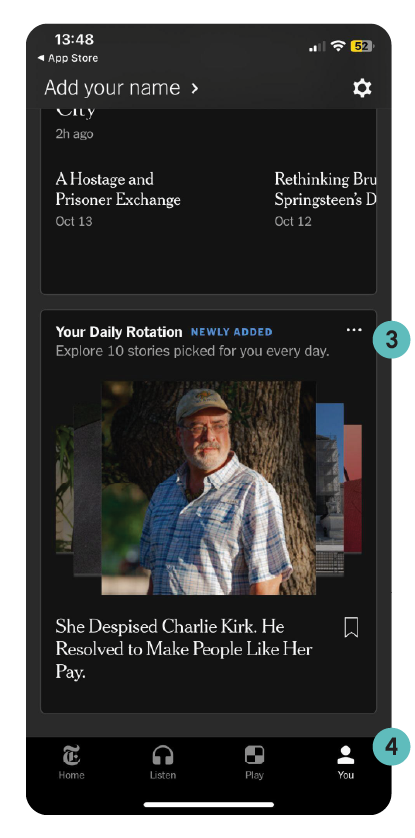
- "Your Daily Rotation" offers 10 personalized stories each day based on your interests, behaviors and demographics
- The 'You' tab is a permanent bottom navigation feature to encourage discovery and engagement