Processing complex topics by exploring different perspectives
In the Sensemake mode, individuals are looking to explore different viewpoints and perspectives on complex topics. Unlike Study, where the goal is factual depth, Sensemake is about exploring different viewpoints to form opinions. This mode is driven by curiosity and a desire for co-learning spaces where producers and audiences engage openly, and sometimes combatively, to make sense of the world together.
Consumer need
In Sensemake, next gen news consumers search for accessible ways to process and understand complex topics. Unlike the Study mode, in which the goal is deeper factual understanding, Sensemake is how consumers explore different viewpoints and perspectives about the news to form their own opinions. In this mode, they hope to weigh different perspectives as part of a broader quest to understand their own political and social position on current events.
This mode is highly social. Consumers are looking for spaces to reach consensus with others about what is happening or to situate themselves near to or apart from others' opinions online. Consumers in this mode value transparency and authenticity, as they promote better alignment with their beliefs.
If there is some breaking news that is starting a lot of chatter, I'll go to Reddit to see what people have to say about it."
X helps me keep up with the breaking news and trending topics in real time. Unlike traditional news, I can quickly see reactions from different people and get a sense of public opinion. It's great for discovering updates quickly and seeing a variety of viewpoints.
The best part of [Raiam Santos's YouTube channel] is that I can see other people's opinions, people without the filter that journalists usually have. Journalists have to remain impartial, but here I can see someone's position on a subject, which is interesting because I can agree or completely disagree. [Raiam Santos] is good because he has many polemical opinions, sometimes very good, well-thought opinions. That's the difference. This possibility of agreeing or disagreeing is very good. It's easier to interact with him than with a journalist, and since he has a big audience, I also find other people with similar opinions. That's really good.
What triggers Sensemaking?
- Seeing updates and synthesis along with the crowd as breaking news or other information is still coming out
- When arguments are obvious online
- When bias feels obvious or assumed based on topic
- When a topic is too broad to understand
Sensemaking behaviors
- Talking with friends and family in person or over text
- Reading comments
- Reading online social commentary
- Searching social media for opinions on a specific topic or story
- Seeking relatable, human-to-human content explaining context and interpretation
In the Sensemake mode, audiences search for help interpreting complex or contested stories. They want to see how others are thinking through and weighing viewpoints, reactions and emotions to arrive at their own position. The production challenge is to create spaces that invite perspective and transparency, helping audiences process disagreement and find orientation amid uncertainty.
How news producers can respond
Create Open Conversations
Host long-form unscripted conversations that let people share their perspectives
Leading news producers know audiences value spaces where those they trust can think aloud, test ideas and listen to others do the same. Openness about beliefs and uncertainties builds trust and makes conversations more engaging, as audiences witness opinions forming and evolving in real time. This concept of transparency of intention — being transparent about any conflicts of interest, agendas or biases a person may have — was a key principle we identified in our previous research.
- Create open spaces for honest conversation where producers and audiences can think aloud. Leading news producers use podcasts and long-form videos to invite audiences into this process, turning explanation into conversation and performance into shared understanding. Channel 5 with Andrew Callaghan exemplifies this by letting people speak at length, reclaiming a form of dialogue that traditional broadcast interviews have largely lost to confrontation and control. His open, unhurried questioning spans two distinct formats — street interviews with everyday people and longer conversations with public figures — designed to create space for reflection rather than reaction. His Two Years Later series extends that ethos by re-interviewing individuals and communities from earlier videos to show how they have evolved over time, making continuous coverage a central element of accountability and care in reporting. The Ezra Klein Show, by contrast, demonstrates openness through structured intellectual exchange. Each episode begins with a clearly stated argument or hypothesis, which Klein tests through reflective, clarifying questions and careful summarization of his guest's perspective.
- Clearly disclose your intention, bias or viewpoint. Successful news producers encourage hosts to briefly explain their point of view, making their opinions clearly visible. This builds credibility and honesty, inviting audiences to examine their own biases with openness as well. The Rest is Politics achieves this by grounding the hosts' differing political backgrounds and by making those perspectives an active part of their exchange. Rather than simply stating their positions, Rory Stewart and Alastair Campbell prompt each other to reflect on how their past experiences shape their interpretations of current events. This conversational questioning makes their viewpoints feel organic and exploratory, turning their personal experiences into a shared way of understanding and contextualizing the news.
The Ezra Klein Show: "We are going to have to live here with each other"
Ezra Klein sets the context of the conversation with a 3-10 minute introduction explaining what the topic will be, what his position on it is and why he invited his guest
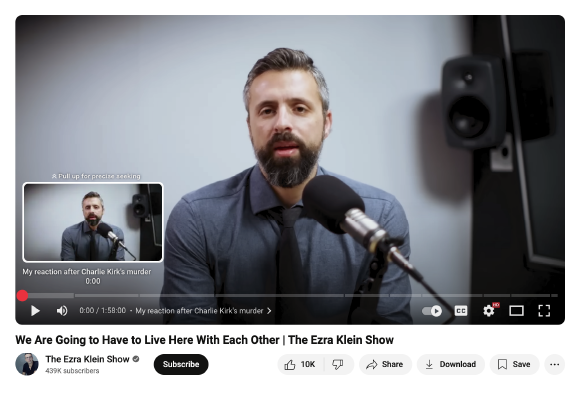
Transcription excerpt: "I want to create a space that takes our disagreements seriously...but does so without deepening our divisions irreparably. I taped an episode with Ben Shapiro, he is well to my right, a person with whom I have many disagreements and also good conversations. And this one was no different. You learn things talking to people you don't expect."
After the context, he welcomes his guest who then explains their own position, hypothesis, or experience on the topic
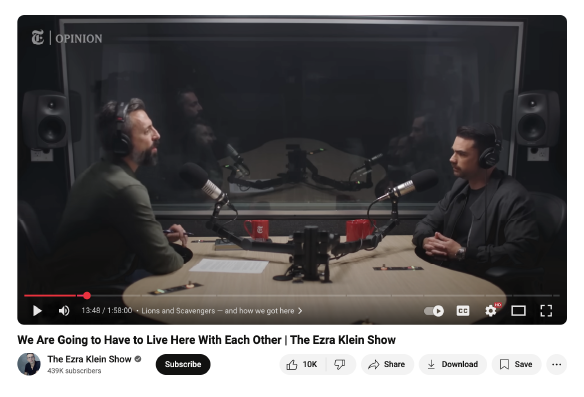
Transcription excerpt: "So, let's get into your book. You have a theory of two groups here, lions and scavengers. What's a Lion? What's a Scavenger?"
Throughout the conversation, Ezra tries to clearly summarize his guests points and follows-up with either rebuttals or further questions
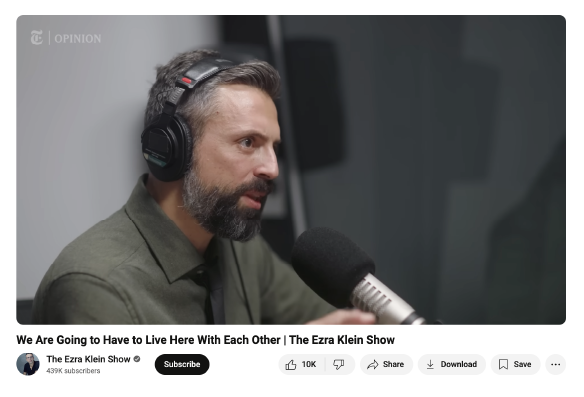
Transcription excerpt: "This feels to me like a more narrow argument of political strategy and I don't even totally disagree with it. But I want to push you a little bit into something more fundamental here..."
Orient the Audience
Use clear, thoughtful design to highlight perspectives and aid understanding
Leading news producers complement long-form unscripted conversations with intentional structure, using visual, audio and editorial cues that help audiences easily understand which perspective is being presented.
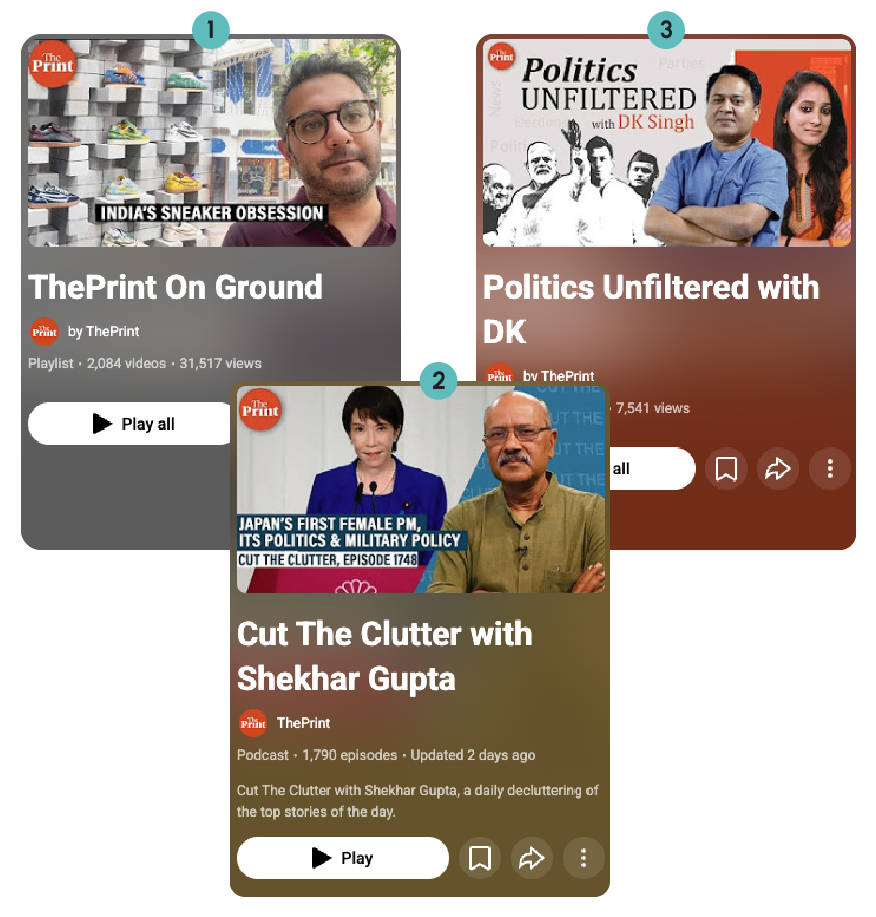
- Vary show formats to deepen engagement and reach audiences across information needs. Successful news producers create deep-dive episodes that unpack background, add follow-up Q&As to respond to audience questions, and showcase interviews with key players offering fresh perspectives. ThePrint demonstrates this effectively across its ecosystem: ThePrint On Ground focuses on the lived experiences of everyday people; Cut the Clutter uses thoughtful design choices to show different perspectives and make breaking news easier to follow; and Politics Unfiltered with DK frames deeper civic questions through a longer explanatory Q&A style. This approach provides audiences with a variety of formats and multiple ways to connect with the same ideas, something our previous research revealed to be vital. Successful news producers pair this diversity of format with consistent, visible signposts that help audiences navigate complexity. They clearly label sections such as 'The Facts,' 'The Debate' or 'Why It Matters', and support them with visual cues such as side-by-side frames or on-screen graphics to help orient audiences. Outlets such as AllSides, Semafor, GroundNews and Tangle News exemplify this, using structured design and transparency tools such as AllSides' Bias Checker to create more convenient, low-effort means to engage with information.
The Print and GroundNews
- The Print effectively creates 3 types of YouTube shows each with a unique purpose of either showing people's perspectives
- Expert opinion
- Two people openly discussing
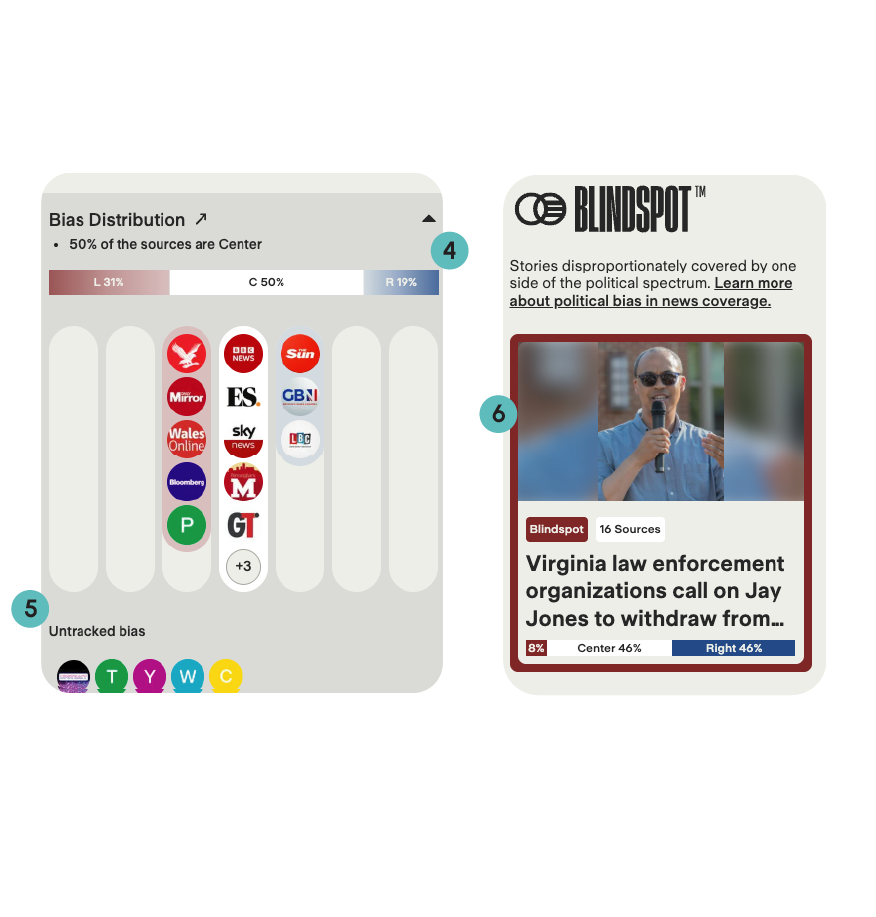
- GroundNews' product focuses on highlighting how different sides of the political aisle cover the same stories, clearly showing which news sources have reported on the story based on their proprietary spectrum that classifies news sources from 'far-left' to 'far-right'
- It clearly indicates whether sources not yet classified on their political spectrum are also covering the stories
- BlindSpot is another feature that identifies stories receiving uneven coverage: extensively reported by one side but scarcely, if at all, by the other
Include the Audience
Be responsive to audience demands and incorporate their viewpoints
Leading news producers understand that Sensemaking is social and participatory. Audiences do not just receive information; they help steer it. As such, live or semi-live formats such as Q&As, comment responses or reaction explainers help news producers turn the news into actionable information for their audiences. This is a vital component of their Ideal News Experience.
- Use livestreams to transform news into a shared, real-time act. Successful news producers turn live moments into spaces where journalists and audiences make sense of events together. Livestreaming creates immediacy and intimacy, bridging the distance between news producer and news consumer. Rather than treating live formats as simple broadcasts, these news producers use them as forums for participation, a place to react, ask, debate and co-create meaning. HasanAbi, one of Twitch's most-watched political streamers, exemplifies this approach. His long, free-flowing daily broadcasts mix reactions to the day's headlines with live responses to breaking news, offering unfiltered commentary that evolves in real time. He makes his own perspective part of the story, turning opinion into a tool for connection and making the act of following the news feel communal. Live interactions further deepen this connection. By surfacing questions from comment sections, direct messages or polls, he leverages audience curiosity to guide the discussion and decide where to dwell. Rewarding participation through on-air recognition or direct replies strengthens this bond and reinforces journalism as a shared act. The Deshbhakt illustrates the same principle in its Saturday Night Livestream, where host Akash Banerjee answers questions — including from paid "super chat" followers — to turn audience engagement into both a community ritual and a revenue stream.
HasanAbi
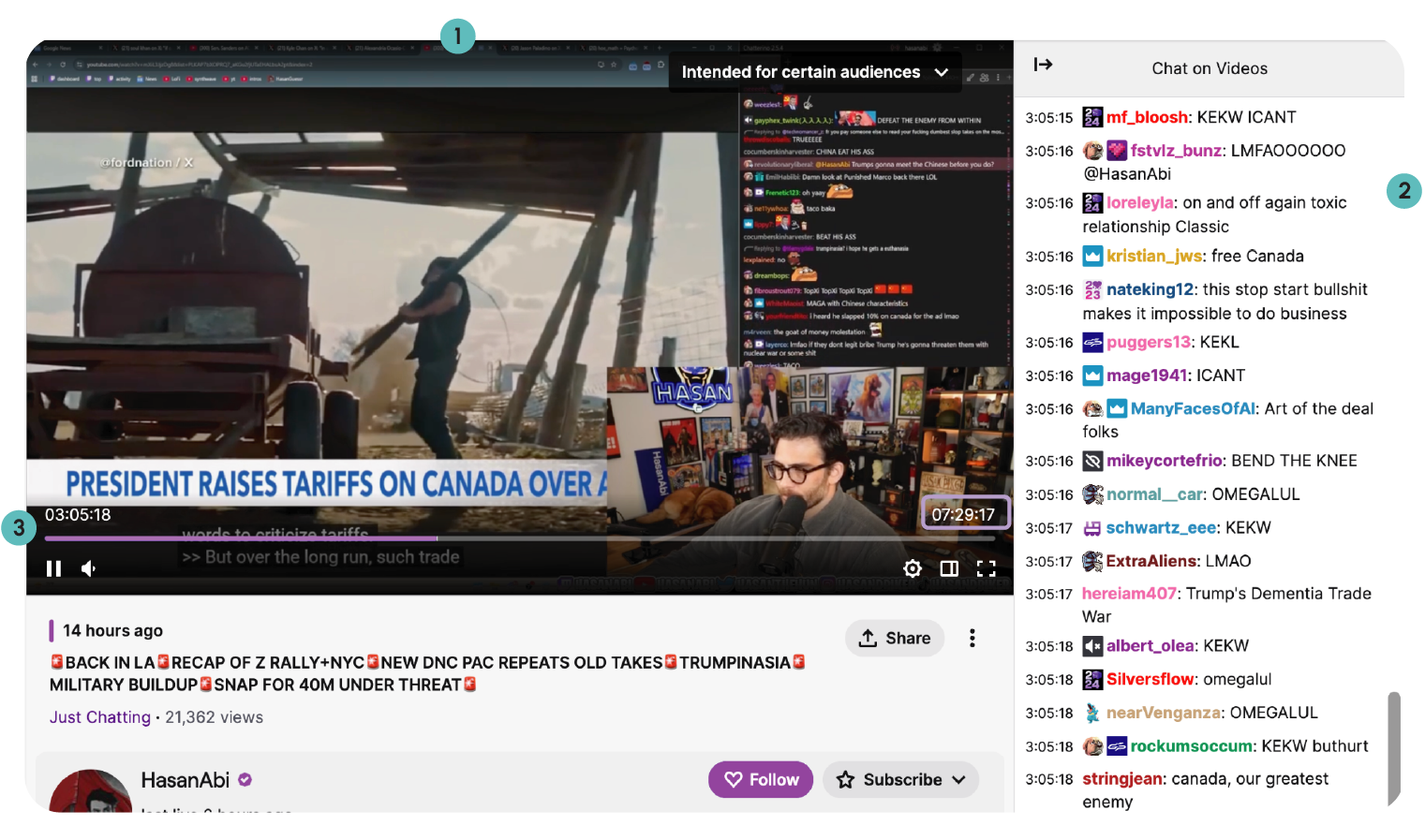
- Hasan watching TV segments and reacting to tweets, usually using humor to give his takes to his audience
- Live chat that respond to video asking questions (and often just reacting to Hasan's takes)
- Seven-hour long unscripted daily streams, making sense of the biggest news of the day
Use Satire Wisely
It should stimulate critical thinking
A segment of leading news producers uses satire to open up space for reflection, often on difficult, divisive or emotionally charged topics. This approach helps people engage with issues that might otherwise feel too polarizing, overwhelming or abstract, and makes them more palatable without diluting their importance. This approach directly meets the language demands of next gen news consumers who want news to be delivered in a way that is informal, humorous and entertaining, as outlined in our previous research.
How news producers achieve this in practice:
- Authentically plug into the zeitgeist. Successful news producers borrow the viral trends and stories of the moment — memes, formats, viral audio clips — and connect them to the real story. A timely meme can be the on-ramp to Sensemaking, allowing people to understand the context, not just the punchline. As Dave Jorgensen of Local News International explained, "We want to come at it in a comedic way that allows people to get the news but also acknowledge that this story is wild ... there's a lot going on and there's news fatigue ... so we're going to do it in a format that's more entertaining than a traditional news report." Jorgensen anchors his short-form videos in viral formats and memes — such as through the use of a famous scene from The Wolf of Wall Street to explain a CDC story — and meets audiences where they already are by turning internet culture into a gateway for news literacy.
- Build recurring inside jokes to make complex topics feel approachable and foster a sense of belonging. Successful news producers create a shared language for their audiences that turns critique into connection. The Daily Show under Jon Stewart mastered this through its recurring correspondent segments, in which exaggerated archetypes — like the overconfident pundit or clueless foreign reporter — parodied broadcast news tropes and built continuity through humor. Similarly, adopting characters or personas to clarify a point can make ideas more tangible. Morning Brew's parody videos, such as its mock Palantir ad, use the voice of a slick corporate spokesperson to expose the absurdities of business culture, sharpening the critique while keeping it entertaining and accessible.
Morning Brew
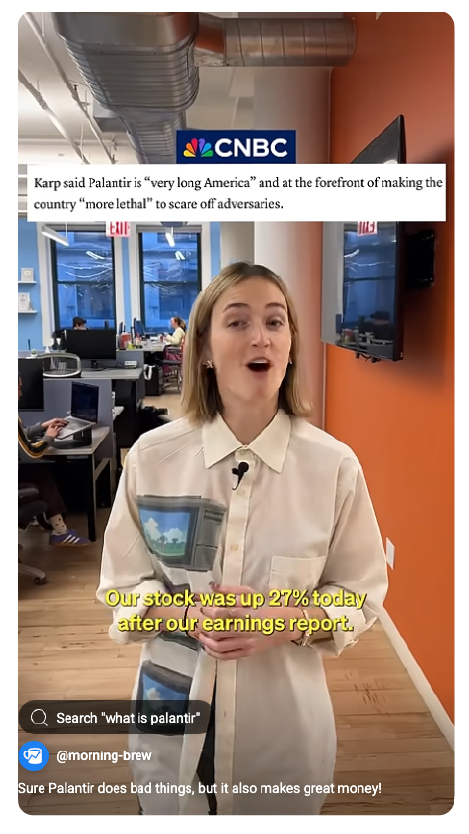
Always linking to the original business story to anchor it to one company and how it's being covered
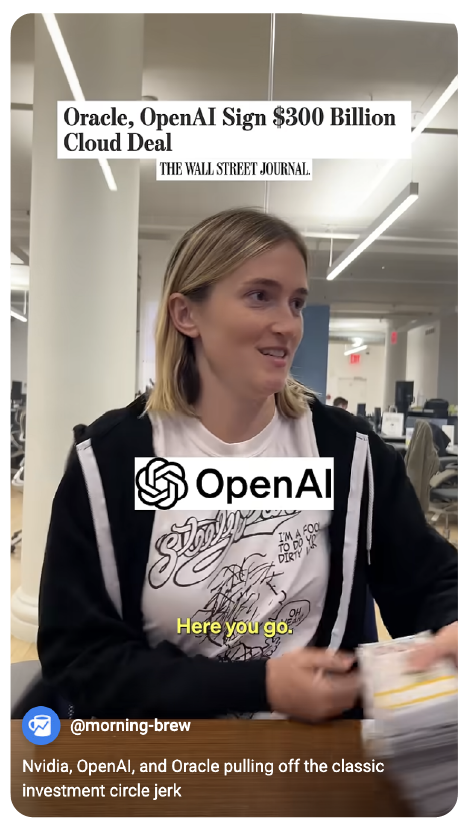
Always using the Morning Brew office as the setting and background to make it recognizable and approachable
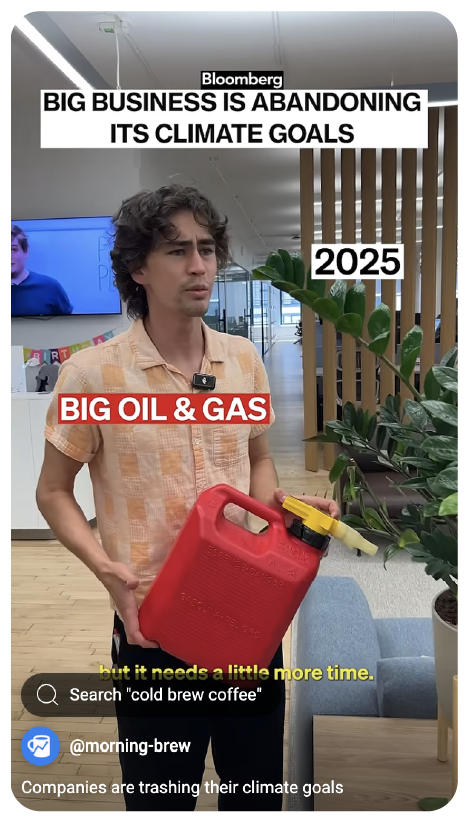
Creating satire of the news through the use of props or funny captions
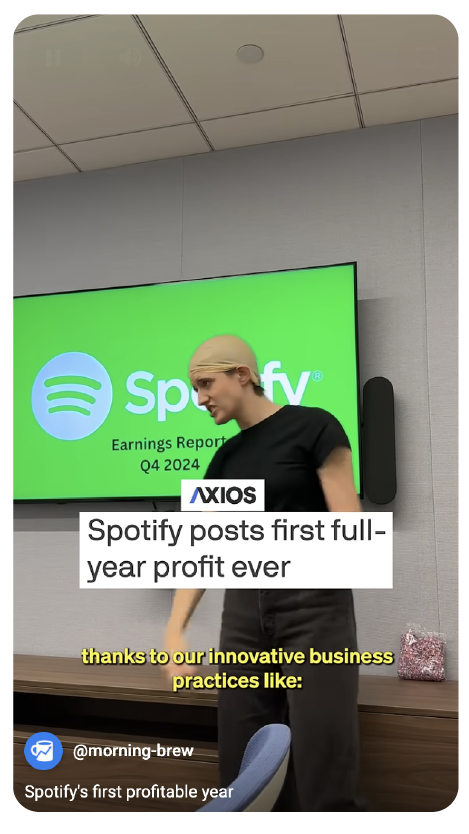
Creating satire through the use of over-the-top personas or characters